There Is Already an AI Shelf for South African Groceries. Most FMCG Brands Don't Know What's on Theirs.
We analysed 61,244 AI responses across seven engines and 156 South African FMCG brands. AI has already chosen which brands to recommend, which to caveat, and which to quietly leave out.

NUDG3
AI Search Intelligence Platform
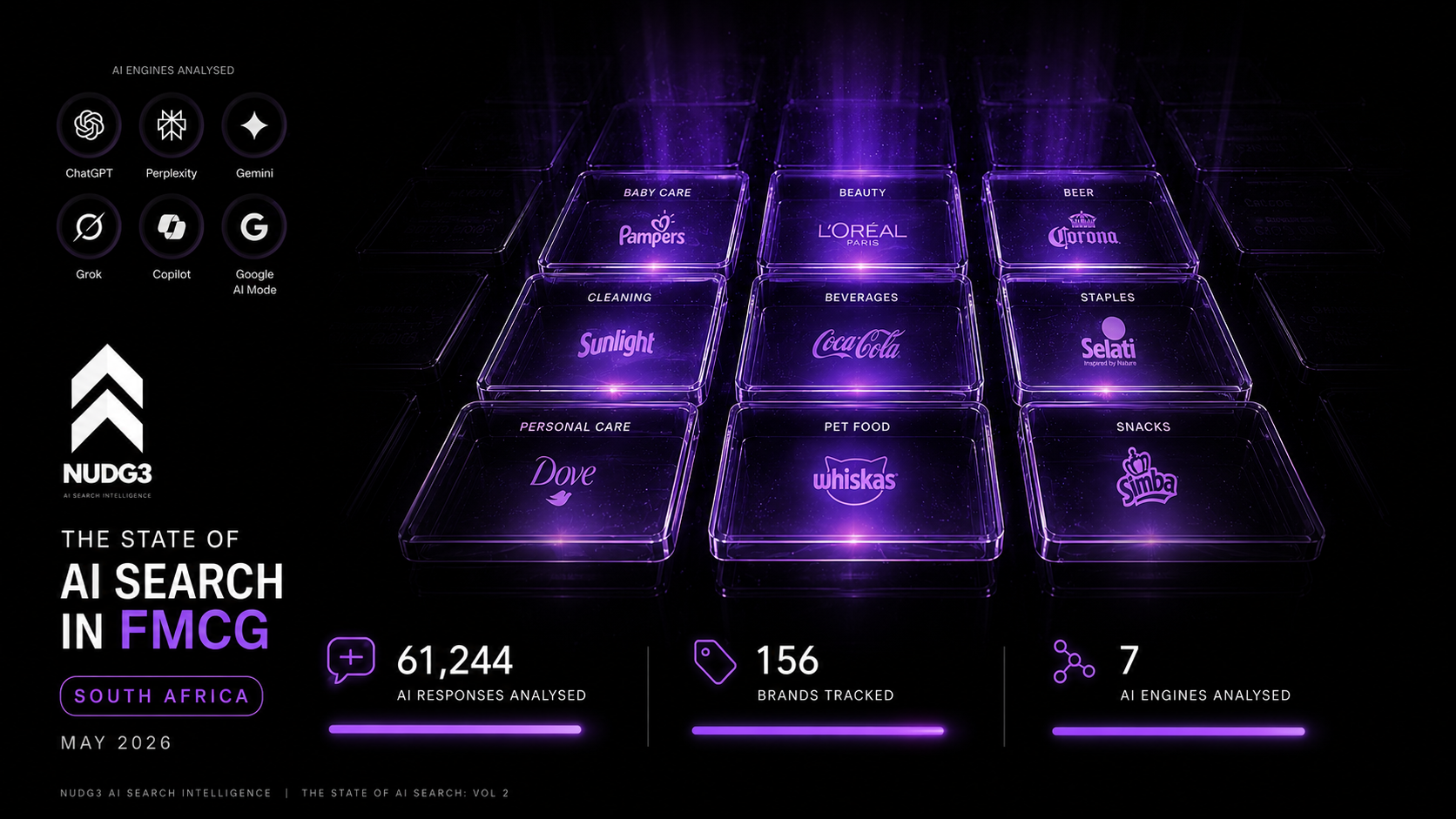
61,244
AI Responses Analysed
Captured across seven AI engines over ten consecutive days, 30 April to 9 May 2026
156
SA FMCG Brands Tracked
Across nine sub-sectors from pet food to staples, beauty, beverages and alcohol
1,002
Consumer Prompts
Designed around discovery, research and purchase-style questions South African consumers actually ask
Based on NUDG3 primary research, tracking 156 brands across 9 FMCG sub-sectors and 7 AI engines, May 2026
Download the Full Report
Get the complete 33-page analysis: 156 brands, 9 sub-sectors, 15 exhibits, 16 brand snapshots, and the 5-part lens framework for reading the AI shelf.
No spam. We'll only use your email to send relevant research.
In this article
A New FMCG Shelf Is Already Live
There is a shelf for South African FMCG that almost no brand is actively merchandising.
It is not in Checkers, Pick n Pay, Spar, Shoprite or Dis-Chem. It is not on Takealot. It is not even on Google's first page of search results.
It is inside an AI answer. Inside ChatGPT, Perplexity, Google AI Overviews, Google AI Mode, Gemini, Copilot and Grok. A South African consumer just asked one of those engines a question, and a compressed, interpretive, occasion-aware shortlist of FMCG brands came back.
A parent typed: "What's the safest formula for a newborn in South Africa?" A pet owner asked: "Best affordable dog food for a Labrador?" A shopper enquired: "Which washing powder works best for cold-water washes?" A young couple wondered: "Is Iwisa or White Star better value for a family of four?"
AI did not list 50 options. It named a handful. It explained why. It compared a few. It moved the consumer from open category exploration to a near-purchase shortlist in a single response. That is not a search result. That is a recommendation.
Across ten consecutive days we tracked 61,244 of those responses, watching how seven AI engines surface 156 South African FMCG brands. The pattern is unambiguous: AI has already formed a view of this market, and most brands have no idea what AI is saying about them.
The AI Answer Is a Shelf, Not a List
A retailer shelf shows many options. A search results page lists many links. An AI answer does something different. It compresses an entire category into a handful of names and a short rationale for why those names matter.
AI answers do not reproduce brand fame. They do not reproduce retail share. They reproduce answerability - a quiet new commercial property that combines local relevance, source quality, narrative clarity and the brand's ability to be explained in one breath.
Some brands win this shelf because they are easy for AI to explain. Some win because they are trusted in the source layer (retailer pages, social platforms, review sites, specialist publications). Some appear only when the consumer signals they are ready to buy. Others are visible but carry weaker sentiment, more caveats, or contested narratives.
In our dataset, Montego and Royal Canin dominate raw mention volume because pet nutrition is a high-consideration, comparison-led, advice-heavy category. Nivea, Sunlight, Rhodes, Castle Lager, Lucky Star, KWV, Dove, Coca-Cola, Simba and Iwisa round out the AI shelf brands. None of those rankings come from a survey. They come from how AI chose to answer South African consumer questions in ten consecutive days of measurement.
“AI does not reproduce brand fame. It does not reproduce retail share. It reproduces answerability - a quiet new commercial property combining local relevance, source quality, and the ability to be explained in one breath.”
This Is Not a 2027 Problem. It Is a Right-Now Problem.
The instinct in most marketing rooms is to file AI search under "emerging trends." Something for the innovation team to watch. Maybe revisit at the next strategy offsite. That instinct is dangerously wrong for FMCG specifically.
ChatGPT now has more than 900 million weekly active users globally, processing roughly 2.5 billion daily prompts. Google AI Overviews appear in approximately 48% of all tracked search queries - meaning for every second search a South African consumer runs, an AI-generated answer sits above the traditional blue links. Perplexity grew its query volume by 239% in under a year. These are not projections. They are current numbers.¹
In South Africa specifically, a reported 15.3% of internet users (approximately 7.8 million people) actively engage with ChatGPT, and a Fast Company SA survey put broader AI usage at 90% of respondents in October 2025.² South African consumers are not waiting for permission to ask AI about household products. They are already doing it.
Globally, the major consumer-goods consultancies are aligned on the direction of travel. Bain frames the shift as a move from search-led demand generation to AI- and algorithm-mediated product discovery. BCG positions GenAI as a confidence-building tool that consumers increasingly trust for shopping decisions. McKinsey describes AI as reshaping grocery across demand, decisioning and execution.³ South African FMCG is in the same conversation - it just is not as loud yet.
The 5-Part Lens: How to Read the AI Shelf
AI visibility cannot be read as a single rank. It is a brand environment with five distinct dimensions, and a brand can perform well on one while being quietly weak on another.
Our report uses a five-part framework that we believe should become standard for any FMCG brand assessing AI exposure. We have applied it to all 156 brands in the dataset:
| Lens | Question answered | Why it matters |
|---|---|---|
| 1. Visibility | Which brands are mentioned and how often? | Share of answer and presence in top recommendation sets. |
| 2. Framing | Is the brand described positively, neutrally, comparatively or negatively? | Sentiment, validated negative share and prompt context type. |
| 3. Funnel movement | Does the brand strengthen from discovery to research to purchase? | Some brands lead awareness; very different brands close the sale inside AI. |
| 4. Occasion ownership | Which real-world moments does AI attach to the brand? | Load-shedding, pantry stocking, family value, trade-up, sugar-health, braai, lunchbox. |
| 5. Provider reality | Which AI engines favour or suppress the brand? | ChatGPT, Google AI surfaces, Perplexity, Gemini, Copilot and Grok behave differently. |
AI Has a Purchase Shelf - and It Is Not the Discovery Shelf
One of the strongest findings in the dataset is the emergence of purchase-stage closers. These are brands that may not lead open discovery questions but become much more prominent when the consumer asks where to buy, what is good value, which option is practical for a household, or which retailer has the best price.
Iwisa is the clearest example. In packaged-food staples, Lucky Star, Sasko and KOO lead AI discovery answers - but when prompts shift to purchase, Iwisa surges to a 32.9% category share. White Star follows the same pattern. In personal care, Nivea and Dove lead discovery, but Dove closes harder at purchase. In household cleaning, Sunlight extends its lead from 18.5% discovery to 35.3% purchase. In pet food, Montego rises from 37.1% of discovery answers to 61.7% of purchase answers (a directional purchase finding based on a smaller sample).
Axe, Frimax, Surf, Clere and Sparletta also show pronounced discovery-to-purchase lift. AI is creating a practical buying shelf that differs from the broad awareness shelf - a shelf where availability, value cues, household practicality and pack-size mention move a brand into the consumer's near-purchase shortlist.
This matters because purchase prompts are closer to the moment of action. AI can shift from a category explainer to a quasi-retail advisor, narrowing the brand universe to the few names it can confidently connect with value, availability, retailer choice or daily household usage.
“AI is creating a practical buying shelf that differs from the broad awareness shelf - a shelf where availability, value cues and household practicality move a brand into the consumer's near-purchase shortlist.”
Being Mentioned Is Not the Same as Being Recommended Well
The second separation in the data is between visibility and sentiment. They are not the same asset. Some brands appear frequently and are framed positively. Some appear frequently but with caveats, comparisons or negative associations. Others are not the loudest by mention volume but show exceptionally strong positive framing whenever they do appear.
Sta-Soft, Lucky Star, Ouma Rusks, Hill's Science Diet and KWV all stand out as high-quality sentiment assets. They are not necessarily the highest-volume brands, but when they appear AI describes them with confidence - through softness and fragrance for Sta-Soft, value and pantry-staple framing for Lucky Star, nostalgia and household familiarity for Ouma Rusks, specialist nutrition for Hill's Science Diet, and premium heritage for KWV.
By contrast, Coca-Cola is highly visible but more narratively exposed. AI frequently surfaces sugar, health, reformulation and comparison narratives when describing the category. Red Bull, Huletts, Bobtail, Fanta, Pepsi, Sprite and Liqui-Fruit also show elevated validated negative exposure - not because they are weak brands, but because their AI narratives are more contested.
For a CMO, this is a new kind of brand risk. In traditional media tracking, a brand can monitor coverage and act on sentiment. In AI search, the risk is quieter: a consumer asks a practical question and receives a recommendation that includes caveats, comparisons or negative associations - and the brand never knows the conversation happened.
Some Categories Are Already Won. Others Are Wide Open.
Concentration varies dramatically by sub-sector. The strategic task differs accordingly. In concentrated categories, the battle is displacement. In fragmented categories, the battle is becoming one of AI's few trusted defaults before someone else does.
Beauty & Cosmetics is the most concentrated AI category in the dataset. Nivea leads discovery at 40.4%, followed by Portia M at 20.9% and Vaseline at 15.5%. Pet Food & Care is similarly compressed: Montego at 37.1%, Royal Canin at 34.8%, Eukanuba at 12.3%. These are categories where AI has effectively settled on a small recommendation set, and where displacing a leader requires a brand-narrative and source-ecosystem investment, not a media campaign.
By contrast, Beer & Alcoholic Beverages, Non-Alcoholic Beverages and Packaged Food Staples are far more fragmented. Coca-Cola leads non-alcoholic discovery at only 9.1%. Castle Lager leads beer at 10.5%. Lucky Star leads packaged staples at 9.9%. These are categories where there is no single AI default yet - and where a determined challenger can claim ownership of specific occasions, sub-categories or consumer questions before the model's preferences harden.
| Sub-sector | Top 3 discovery brands (share of AI mentions) |
|---|---|
| Baby & Infant Care | Huggies 19.7% / Pampers 17.7% / NAN 17.5% |
| Beauty & Cosmetics | Nivea 40.4% / Portia M 20.9% / Vaseline 15.5% |
| Beer & Alcoholic Beverages | Castle Lager 10.5% / KWV 10.1% / Castle Lite 8.9% |
| Household Cleaning & Laundry | Sunlight 18.5% / Omo 11.6% / Maq 8.5% |
| Non-Alcoholic Beverages | Coca-Cola 9.1% / Nescafé 6.6% / Liqui-Fruit 6.5% |
| Packaged Food Staples | Lucky Star 9.9% / Sasko 9.3% / KOO 7.6% |
| Personal Care & Hygiene | Nivea 18.4% / Dove 16.2% / Vaseline 9.4% |
| Pet Food & Care | Montego 37.1% / Royal Canin 34.8% / Eukanuba 12.3% |
| Snacks & Confectionery | Simba 15.6% / Bakers 11.9% / Beacon 8.0% |
AI Owns Occasions, Not Just Categories
Marketers have spent decades teaching brands to own categories. The data suggests AI has already moved further: it is mapping brands to occasions - the specific real-world contexts a consumer is solving for when they reach for AI.
Surf over-indexes inside load-shedding laundry contexts and cold-water wash questions. Sta-Soft over-indexes inside trade-up household care contexts. Parmalat strengthens inside pantry-stocking conversations. Castle Free strengthens inside health-reformulation and alcohol-free contexts. Fanta, Coca-Cola and Sprite all carry heavier sugar-health scrutiny in comparative prompts. Iwisa and White Star strengthen inside South African family-value pantry conversations.
Occasion ownership is a quieter form of AI authority than category leadership, but it may be more durable. Categories evolve; occasions stay close to how consumers actually think. A brand that owns load-shedding laundry in 2026 has a defensible AI position even if the category leader changes hands.
This is a new asset class for FMCG marketers: the occasion map. Most marketing teams do not currently know what occasions AI has attached to their brand. That is something the industry needs to start measuring, deliberately, before the model preferences calcify.
“Occasion ownership is a quieter form of AI authority than category leadership. Categories evolve; occasions stay close to how consumers actually think.”
There Is No Single AI Shelf
A blended AI visibility score - the kind a quarterly brand-tracker dashboard might produce - hides provider-specific realities that materially change how brands win or lose. ChatGPT, Google AI Overviews, Google AI Mode, Perplexity, Copilot, Gemini and Grok do not behave the same way. They differ in source depth, comparative tone, brand density per response and domain reliance.
Hill's Science Diet over-indexes on Google AI surfaces. Castle Lager over-indexes on Perplexity. Sprite over-indexes on ChatGPT. Bobtail over-indexes on Copilot. These are not random fluctuations - they reflect each engine's underlying source pool, training data and answer style.
Google AI Mode and Gemini surface more brands per response, which means a challenger has more room to be included. Perplexity is the most comparative engine, which means brands need to be ready to be put side-by-side with rivals. Grok draws from a much wider source pool, which can favour brands with strong social-platform presence. ChatGPT leans on patterns embedded in its training data, which can favour brands with deep prior media coverage.
Brand performance, in other words, must be interpreted as a portfolio across AI surfaces. A strong position on Google AI Overviews does not translate to a strong position on Perplexity. Treating AI search as one channel is the same category error as treating all retailers as one channel - and it leads to the same outcome: blind spots that become someone else's growth opportunity.
The Answerability Model: Why Some Brands Rise and Others Fade
AI does not reward scale in a linear way. It rewards answerability - a brand's ability to be connected to a clear consumer problem, supported by enough source material, locally relevant, and easy to explain in a short response.
Five drivers shape answerability in the dataset:
Question density - categories that invite advice, comparison or reassurance produce more AI-rich answers. Pet food, baby care, skincare and cleaning all benefit. Decision complexity - AI is more useful when consumers need to weigh trade-offs (premium vs value, safety vs price, cold-water vs stain removal). Brand clarity - brands with simple, repeated associations are easier to surface. Montego is local pet nutrition. Iwisa is maize meal. Sta-Soft is softness and fragrance. Source ecosystem - AI depends on the evidence it can retrieve and synthesise: retailers, reviews, specialist sites, social platforms, brand-owned content. Local relevance - South African cues matter when prompts are local. Load-shedding, family value, Checkers/Clicks/Dis-Chem, maize meal, braai and pantry stocking all show up as discriminators.
The core rationale is simple but commercially uncomfortable: AI is not asking which company is largest. It is asking which brand best resolves the user's question with enough confidence to be mentioned. A brand with global scale, distribution muscle and decades of awareness can still be invisible in a category if the AI cannot answer for it.
“AI is not asking which company is largest. It is asking which brand best resolves the user's question with enough confidence to be mentioned.”
The Source Layer: Who Is Really Writing Your AI Narrative
AI systems do not form FMCG brand narratives in a vacuum. They draw on a mix of social platforms, retailers, marketplaces, comparison domains, specialist sites, news sources and brand-owned pages. In our dataset, social and retailer domains dominate the source layer for South African FMCG.
Facebook, Instagram, TikTok, Reddit and YouTube appear heavily. PnP, Clicks, Woolworths, Dis-Chem and Checkers carry significant weight on retailer-anchored questions. Amazon shows up more often than many South African marketers might expect - particularly on pet food, supplements and health-related queries.
This is consistent with broader research outside the dataset. McKinsey's AI Discovery Survey (2025) found that a brand's own website accounts for only 5-10% of the sources AI platforms reference when describing that brand.⁴ Edelman put the number even higher: up to 90% of citations driving LLM brand visibility come from earned media rather than owned media.⁵ In financial services specifically, Fintel Connect found more than 60% of citations in AI product recommendations came from publishers and affiliate sites, not the brands themselves.⁶
Applied to FMCG: a brand's pack design, its TVC, its retailer planogram and its website together account for perhaps a tenth of how AI describes it. The other 90% is written by retailers, reviewers, Reddit threads, TikTok comparisons, YouTube reviews, news coverage, comparison sites and consumer discussions. That is the source layer. It is the new battleground.
Challenger and Local Brands Can Outperform Their Size
A striking pattern in the dataset is the over-performance of challenger and local-heritage brands. Montego, Iwisa, White Star, Lucky Star, Portia M, Maq, Clere, Mrs Balls, Castle Lager and KOO all punch above their global scale because they carry local clarity that AI can recommend with confidence.
Challenger-disruptor brands also show the strongest average sentiment in the dataset. The likely reason is not size - it is clarity. Narrower positioning, cleaner narratives, and a single category claim are easier for AI to summarise positively than the diffuse messaging of a portfolio incumbent.
This runs counter to a well-documented bias in large language models, which historically have been shown to associate global brands with positive attributes and local brands with negative ones.⁷ South African FMCG appears to be a partial exception. When prompted in a South African context, AI can become highly local - but only for brands with enough recognisable local signal in the source layer. The brands that have invested in being talked about in local terms, by local retailers, in local reviews and on local social platforms, win this advantage. The brands that have not, do not.
Why Some Big Brands Are Quietly Absent
Some large FMCG companies and well-known brands appear less prominently in the dataset than category share would predict. This should not automatically be read as market weakness. AI does not reason from corporate ownership or portfolio scale. It reasons from the brand-level answer to a specific consumer question.
Five factors recur across underperforming brands:
Portfolio fragmentation - large groups are often visible through many individual brands rather than as a single corporate entity. AI will recommend Dove, Sunlight, Nescafé, Kit Kat or Omo before it recommends the parent. Generic category language - brands without a distinctive, source-backed reason to be recommended default to silence as AI surfaces a clearer rival. Lower question density - habitual or impulse-led products invite less AI advice than reassurance-led or comparison-led ones. Weak source layer - brands with limited current, structured, local or third-party evidence may be known offline but less answerable online. Risk-sensitive moderation - categories involving infant nutrition, health, alcohol, sugar or safety produce more cautious recommendation behaviour from AI models that are trained to hedge.
The public-market implication is significant: the AI shelf breaks FMCG into thousands of micro-battles - value, family use, safety, nutrition, convenience, retailer choice, trade-up moments, private-label comparison and South African household constraints. Brands win or lose at the level of these questions, not at the level of the brand portfolio.
What South African FMCG Marketers Should Do About This
This piece is not a strategy guide. It is a provocation. But there are questions every CMO, Brand Director, Category Manager and Insights Lead in South African FMCG should be asking right now.
Do you know your share of answer? Not your share of search. Not your share of voice. The percentage of relevant AI responses that mention your brand, ranked against the percentage that mention each direct competitor. Across all seven engines, not just the one your innovation team likes.
Do you know which occasions AI has attached to your brand? Load-shedding, lunchbox, braai, pantry-stocking, family value, trade-up, health-conscious, retailer-availability. Each one is a micro-battle. Some you are already winning. Some you are losing without knowing it.
Do you know how your brand performs across the funnel inside AI? AI is no longer a single answer engine. It is a discovery engine, a research engine and a purchase engine - three different shelves with different brand rankings. A brand that leads discovery but disappears at purchase is leaking commercial value invisibly.
Do you know which AI engines are friends and which are foes? Your over-indexing on Google AI surfaces is meaningful. Your under-indexing on Perplexity is meaningful. Your absence from Grok is meaningful. Treating AI as one channel is treating retailers as one channel.
Is your earned media strategy designed for AI, or just for humans? If 90% of what AI says about you comes from third-party sources, your PR, retailer-content, social proof, review-management and Reddit/TikTok presence are now AI-visibility strategy. Whether you designed them that way or not.
Are you measuring any of this systematically? Traditional brand tracking measures awareness, consideration and preference among humans. AI search introduces a new layer: what do the machines recommend, in what context, with what framing? It is measurable. Almost no South African FMCG brand is measuring it yet.
The Window Is Open. It Will Close Quietly.
AI shelves harden over time. Each cycle of consumer queries, each round of model updates, each new retailer integration reinforces the brands AI has already learned to recommend. The brands that move first - that audit their share of answer, that invest in the source layer, that own specific occasions before someone else does, that pressure-test their AI position across all seven engines - will have a compounding advantage that late movers will struggle to close.
Most South African FMCG brands have not started this conversation in earnest. That is both a risk and an opportunity. The risk is that competitors who do start now will own the answer space before anyone else realises there is an answer space to own. The opportunity is that the field is genuinely open: no FMCG brand in this country has yet built a fully deliberate AI-visibility strategy.
Because in AI search, unlike traditional search, there is no page two. There is only the answer. And your brand is either in it, or it isn't.
“In AI search, unlike traditional search, there is no page two. There is only the answer. And your brand is either in it, or it isn't.”
References
1. OpenAI usage data and Perplexity AI growth figures (2025-2026); BrightEdge AI Overview Tracking Report, February 2026. BrightEdge serves 57% of the Fortune 500 and reports 750+ organisations use its AI monitoring tools daily.
2. DataReportal, "Digital 2025: South Africa" (January 2025); Fast Company SA, AI adoption survey (October 2025).
3. Bain & Company, "Rewiring Demand Generation in the Age of AI Agents" (2026); Boston Consulting Group, "Consumers Trust AI to Buy Better. Brands Must Adapt" (2026); McKinsey & Company, "The State of Grocery Retail Europe 2026".
4. McKinsey & Company, "AI Discovery Survey," August 2025.
5. Edelman, "Earned Media and AI Visibility Research" (2025).
6. Fintel Connect, "AI Citations in Financial Product Recommendations" (2025).
7. Kamruzzaman, M., Nguyen, T., and Kim, J., "Global is Good, Local is Bad? Understanding Brand Bias in LLMs," EMNLP 2024.
8. IMARC Group, "South Africa Pet Food Market Size, Share & Forecast" (2025); Reuters, "Amazon South Africa expands into groceries, pet food and health supplements" (June 2025); Boston Consulting Group, "How Agentic AI Is Transforming Retail Merchandising" (2026).
Frequently Asked Questions
Download the Full Report
Get the complete 33-page analysis: 156 brands, 9 sub-sectors, 15 exhibits, 16 brand snapshots, and the 5-part lens framework for reading the AI shelf.
No spam. We'll only use your email to send relevant research.
Book a Demo
Monitor your brand visibility across 11 AI engines. Get actionable insights to improve how AI recommends you.